UP TGT Science New Syllabus 2026: Physics, Chemistry, GK, PDF & Exam Pattern
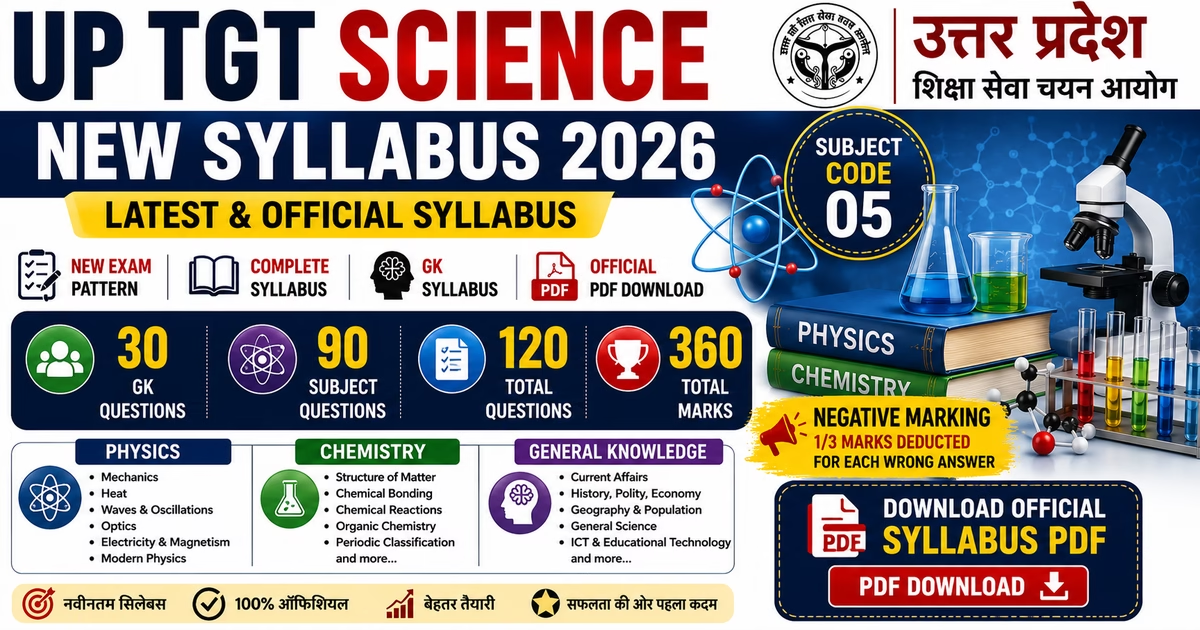
UP TGT Science New Syllabus 2026 की पूरी और व्यवस्थित जानकारी एक ही स्थान पर। इस लेख में Official Syllabus PDF के आधार पर Physics, Chemistry और General Knowledge के topics को आसान एवं व्यवस्थित तरीके से समझाया गया है।
साथ ही UP TGT Science Exam Pattern, 30 GK Questions, 90 Subject Questions, 360 Written Marks, Negative Marking, Official Syllabus PDF Download और Preparation Strategy की जानकारी भी दी गई है।
UP TGT Science के नवीन syllabus में Physics और Chemistry से संबंधित विस्तृत topics दिए गए हैं। इसके अतिरिक्त TGT एवं PGT के लिए अलग से General Knowledge के 30 Questions का common syllabus निर्धारित किया गया है।
इसलिए Science की तैयारी करने वाले अभ्यर्थियों को केवल अपने subject की तैयारी ही नहीं, बल्कि निर्धारित GK syllabus को भी अपनी preparation strategy में शामिल करना चाहिए।
यदि आप UP TGT Science 2026 की तैयारी कर रहे हैं और Google पर UP TGT Science Syllabus 2026, UP TGT Physics Syllabus, UP TGT Chemistry Syllabus, UP TGT Science PDF, UP TGT Science Exam Pattern जैसी जानकारी खोज रहे हैं, तो यह article आपके लिए उपयोगी reference के रूप में तैयार किया गया है।
📌 UP TGT Science New Syllabus 2026 – Quick Overview
| Particular | Details |
|---|---|
| Post | Trained Graduate Teacher (TGT) |
| Subject | Science |
| Subject Syllabus | Physics & Chemistry sections as provided in the official syllabus PDF |
| General Knowledge | 30 Questions |
| Subject Questions | 90 Questions |
| Total Written Questions | 120 Questions |
| Total Written Marks | 360 Marks |
| Negative Marking | Applicable; 1/3 of the marks allotted to a question for an incorrect answer |
| TGT Interview | नहीं |
संबंधित subject से 90 Questions और General Knowledge से 30 Questions मिलाकर written examination में 120 Questions होते हैं।
प्रत्येक प्रश्न 3 marks का होने पर कुल written examination 360 Marks का बनता है।
Negative Marking: गलत उत्तर पर निर्धारित प्रश्न के अंकों का 1/3 काटा जाएगा। यानी 3 marks के प्रश्न पर गलत उत्तर के लिए 1 mark की कटौती होगी।
UP TGT में Interview नहीं है।
📥 Official UP TGT Science & GK Syllabus PDF
नीचे दिए गए button से UP TGT Science एवं General Knowledge की Official Syllabus PDF सीधे डाउनलोड करें।
📄 DOWNLOAD OFFICIAL SYLLABUS PDF📚 General Knowledge Syllabus 2026 – 30 Questions
Official PDF के पहले दो pages में General Knowledge – Trained Graduate Teacher (TGT) एवं Post Graduate Teacher (PGT) के लिए कुल 30 Questions का syllabus दिया गया है।
🔵 Unit 1 – Current Affairs
- राज्य, राष्ट्रीय एवं अन्तर्राष्ट्रीय महत्व की सामयिक घटनाएँ
- चर्चित व्यक्तित्व
- खेल
🟢 Unit 2 – Indian History, Indian Polity, Indian Economy & Indian Geography
- भारतीय इतिहास एवं भारतीय स्वतंत्रता आन्दोलन
- भारतीय संविधान एवं राज व्यवस्था
- शैक्षिक व्यवस्था से संबंधित विधिक एवं संवैधानिक विकास
- भारतीय अर्थव्यवस्था
- भारत का सामान्य भूगोल एवं जनसंख्या
🟠 Unit 3 – General Science, Information & Communication Technology
- सामान्य विज्ञान, समसामयिक संदर्भ में प्रौद्योगिकी एवं पर्यावरण
- मानव स्वास्थ्य एवं स्वच्छता – विटामिन, खनिज, रोग, अल्पताजन्य रोग, हार्मोन्स एवं एन्जाइम
- कम्प्यूटर और इंटरनेट शब्दावली
- ICT के अनुप्रयोग
- शैक्षिक प्रौद्योगिकी में विकास
⚛️ UP TGT Science Physics Syllabus 2026
Official PDF में Physics syllabus को मुख्य रूप से General Physics (Mechanics), Heat, Waves and Oscillations, Optics, Electricity and Magnetism तथा Modern Physics जैसे sections में प्रस्तुत किया गया है।
1. General Physics (Mechanics)
- इकाइयाँ और विमा
- सदिश एवं अदिश राशियाँ
- गुणनफल – Scalar और Vector Products
- प्रवणता (Gradient)
- Divergence और Curl
- Gauss, Stokes और Green के प्रमेय
- गति, बल एवं त्वरण
- गति के समीकरण
- गतिज एवं स्थितिज ऊर्जा
- रेखीय एवं कोणीय संवेग
- ऊर्जा एवं संवेग का संरक्षण
- संरक्षी एवं असंरक्षी बल
- घूर्णी गति
- केन्द्रापसारी एवं अभिकेन्द्रीय बल
- गुरुत्वीय बल एवं केन्द्रीय बल
- केपलर के ग्रहों की गति के नियम
- Geostationary Satellites
- गुरुत्वीय त्वरण
- Escape Velocity
- Simple और Compound Pendulum
- Moment of Inertia
- Parallel और Perpendicular Axis Theorem
- Moment of Inertia of Sphere, Ring और Disc
- Angular Momentum और Torque
- Streamline एवं Turbulent Flow
- Critical Velocity
- Stokes एवं Poiseuille’s Formula
- Bernoulli’s Theorem और Applications
- Surface Tension
- Curved Surfaces of Liquids में Excess Pressure
- Surface Energy
- Capillary में Liquid का Flow
- Elasticity
- Elastic Constants और उनके पारस्परिक सम्बन्ध
- Bending Moment
- Cantilever
- Theory of Relativity
- Change in Length
- Time and Mass
- Mass-Energy Equivalence
2. Heat
- ऊष्मा एवं तापमान की संकल्पना
- विभिन्न ताप मापन पैमाने
- Absolute Temperature
- Thermal Expansion of Solids
- Gases and Liquids
- Conductors and Insulators
- Radiation of Heat
- Black Body Radiation
- Rayleigh-Jeans Law
- Wien’s Law
- Planck’s Radiation Formula
- Newton’s Law of Cooling
- Stefan’s Law
- Internal Energy
- Isothermal and Adiabatic Changes
- First and Second Laws of Thermodynamics
- Carnot Engine
- Entropy
- Maxwell’s Thermodynamic Relations
- Joule-Thomson Effect
- Clausius-Clapeyron Equation
3. Waves and Oscillations
- Simple Harmonic Motion
- Progressive and Stationary Waves
- Phase and Group Velocity
- Damped Harmonic Motion
- Forced Oscillations and Resonance
- Resonance Sharpness
- Superposition of Waves
- Beats
- Lissajous Figures
- Doppler Effect
4. Optics
- Spherical Mirrors and Lenses
- Refractive Index
- Formulas for Focal Lengths
- Coaxial System
- Combination of Thin Lenses
- Eyepiece
- Ramsden and Huygens Eyepieces
- Chromatic Aberration of Lenses
- Huygens Principle
- Longitudinal and Short-Sightedness
- Basic Concepts of Interference, Diffraction and Polarization
- Biprism
- Newton’s Rings
- Fresnel-Fraunhofer Diffraction
- Rayleigh Criterion
- Resolving Power
- Zone Plate
- Working Principles of Gratings
- Double Refraction
- Polarization
- Circular and Elliptical Polarization
- Quarter and Half-Wave Plates
- General Concept of Laser
- Ruby Laser
- Helium-Neon Laser
5. Electricity and Magnetism
- Primary and Secondary Cells
- Internal Resistance
- Electromotive Force
- Laws of Combination of Resistances and Capacitors
- Current
- Drift Velocity and Conductivity
- Galvanometer
- Ammeter and Voltmeter
- Wheatstone Bridge and its Applications
- Electric Field
- Electric Potential
- Gauss Law
- Biot-Savart Law
- Ampere’s Circuital Law
- Electromagnetic Induction
- Faraday’s and Lenz’s Laws
- Self-Induction and Mutual Induction
- Alternating Current
- Series and Parallel LCR Circuits
- Dia-, Para- and Ferro-Magnetism
- Electromagnetic Waves
- Maxwell’s Equations
- Displacement Current
6. Modern Physics
- Structure of Atom
- Vector and Bohr’s Model of Atom
- Pauli’s Exclusion Principle
- Optical and X-Ray Spectra
- Photoelectric Effect
- Compton Effect
- Zeeman Effect
- Paschen-Back and Raman Effect
- de Broglie Waves
- Uncertainty Principle
- Schrödinger Equation
- Radioactivity
- Metals, Semiconductors and Insulators
- P-N Junction
- Zener Diode
- Transistor and their Uses
- Logic Gates
- Truth Tables
- Boolean Algebra
🧪 UP TGT Science Chemistry Syllabus 2026
Official PDF में Chemistry का syllabus भी विस्तार से दिया गया है। PDF के Chemistry section में विषय कोड-05 का उल्लेख है।
1. द्रव्य (Matter)
- द्रव्य की प्रकृति एवं व्यवहार
- द्रव्य के प्रकार
- तत्व एवं उनका वर्गीकरण – धातु एवं अधातु
- यौगिक एवं उनके मिश्रण
2. रासायनिक संयोजन के नियम
- स्थिर अनुपात का नियम
- अवयव एवं व्युत्क्रम अनुपात का नियम
- Multiple Proportions
- Gay-Lussac’s Law of Gaseous Volumes
- Mitscherlich’s Law of Isomorphism
3. पदार्थ की संरचना
- Dalton का परमाणु सिद्धान्त
- परमाणु एवं अणु
- परमाणु एवं अणुओं की विशेषताएँ
4. परमाणु संरचना
- Electron, Proton और Neutron की खोज
- Rutherford का Alpha-Ray Scattering Experiment
- Nucleus की खोज
- Rutherford, Bohr और Sommerfeld के Atomic Models
- Quantum Numbers
- Modern Atomic Theory
- de Broglie Equation
- Heisenberg Uncertainty Principle
- s और p तथा d Orbitals की आकृति
- Aufbau Principle के आधार पर Electronic Configuration
- Hund’s Rule
- Pauli’s Exclusion Principle
5. Radioactivity
- Radioactivity की खोज
- Radioactive Rays एवं उनके Characteristics
- Half Life और Average Life
- Radioactive Decay के Laws
- Nuclear Fission और Fusion
- Artificial Radioactivity
- Isotopes
- Isobars
- Isoelectronics
6. Chemical Bonding
- Valency की मूल अवधारणाएँ
- Electronic Theory
- Octet Rule एवं इसके Exceptions
- Electrovalent, Covalent और Coordinate Bonds
- Ionic, Covalent और Coordinate Compounds की Characteristics
- Polarization और Fajan’s Rule
- Inert Pair Effect
- Valence Bond Theory of Covalency
- Hydrogen Molecule के लिए Valence Bond Theory
- Hybridization
- sp, sp² और sp³ Hybrid Orbitals की आकृतियाँ
7. Chemical Reactions
- Symbols, Ions और Formulae
- Chemical Equations द्वारा Chemical Reactions का Representation
- Physical एवं Chemical Changes तथा उनके Differences
- Displacement Reaction
- Addition Reaction
- Dissociation
- Decomposition
- Double Decomposition
- Slow और Fast Reactions
- Exothermic एवं Endothermic Reactions
- Catalysed Reactions
8. Electrochemical Cells
- Voltaic Cell एवं उसके Working Mechanism
- Dry Cell
- Lead Storage Battery
- Reversible Cell
- Electrode Potential
- Nernst Equation एवं इसके Applications
9. Periodic Classification of Elements
- Mendeleef’s Periodic Classification एवं उसका आधार
- Mendeleef’s Periodic Table के Merits और Demerits
- Modified Form of Periodic Table एवं उसके Important Features
- Elements के Periodic Properties
- Atomic और Ionic Radii
- Ionization Potential
- Electron Affinity
- Electronegativity
- Groups एवं Periods में Periodic Properties का Variation
- s और p Block Elements के General Properties
- First Row Transition Elements (3d Block Elements)
- Electronic Configuration
- Oxidation State
- Colour
- Magnetic Properties
- Complex Compounds Formation
10. General Organic Chemistry
- Inductive Effect
- Electromeric Effect
- Mesomeric Effect
- Hyperconjugation
- Resonance और उनके Applications
- Electrophilic और Nucleophilic Reagents
- Free Radicals
- Carbocations और Carbanions
- Hydrogen Bonding एवं इसके Effects
- Classification of Organic Compounds
- Nomenclature of Organic Compounds
11. Isomerism
- Structural Isomerism
- Stereoisomerism
- Organic Reactions के Mechanism की Concept
- Simple Substitution
- Addition और Neutralization Reactions के Mechanism
12. Selected Organic Compounds – Preparation & Properties
निम्न organic compounds की preparation methods तथा properties syllabus में निर्धारित हैं:
- Alkanes
- Alkenes
- Alkynes
- Alkyl Halides
- Ketones
- Acids और उनके Derivatives
- Benzene – Preparation, Properties एवं Structure
📊 UP TGT Science New Syllabus 2026 – Subject-Wise Summary
| Section | Major Areas |
|---|---|
| General Knowledge | Current Affairs, History, Polity, Economy, Geography, General Science, Health, ICT एवं Educational Technology |
| Physics | Mechanics, Heat, Waves & Oscillations, Optics, Electricity & Magnetism, Modern Physics |
| Chemistry | Matter, Chemical Combination, Atomic Structure, Radioactivity, Chemical Bonding, Chemical Reactions, Electrochemical Cells, Periodic Classification, Organic Chemistry, Isomerism एवं Organic Compounds |
🔗 UP TGT New Syllabus Series – Related Posts
यदि आप UP TGT के किसी अन्य विषय की तैयारी कर रहे हैं, तो हमारी UP TGT New Syllabus Series की ये महत्वपूर्ण posts भी पढ़ सकते हैं।
🎯 UP TGT Science Preparation Strategy 2026
Step 1 – Physics और Chemistry को अलग-अलग Plan करें
Science syllabus को Physics और Chemistry के अलग-अलग sections में divide करके तैयारी करें। इससे इतने विस्तृत syllabus को व्यवस्थित रूप से पूरा करना आसान होगा।
Step 2 – Physics में Concept + Formula Approach अपनाएँ
Mechanics, Heat, Waves, Optics, Electricity & Magnetism तथा Modern Physics के लिए पहले concepts समझें और फिर formulas तथा numerical problems का अभ्यास करें।
Step 3 – Chemistry में Concepts और Reactions पर ध्यान दें
Atomic Structure, Chemical Bonding, Chemical Reactions, Periodic Classification और Organic Chemistry जैसे sections को conceptually तैयार करें।
Step 4 – Important Laws और Principles की Revision करें
Physics में Gauss Law, Stokes Theorem, Bernoulli’s Theorem, Thermodynamic Laws, Faraday’s Law, Lenz’s Law आदि तथा Chemistry में संबंधित laws, theories और principles का नियमित revision करें।
Step 5 – Numerical Practice करें
Mechanics, Heat, Electricity and Magnetism, Optics तथा अन्य numerical-oriented topics में केवल theory पढ़ने के बजाय पर्याप्त questions solve करें।
Step 6 – Chemistry में Reactions और Structures लिखकर अभ्यास करें
Chemical Bonding, Organic Chemistry, Isomerism और Chemical Reactions में concepts को लिखकर और structures/reactions बनाकर revise करना उपयोगी रहेगा।
Step 7 – GK को रोज समय दें
General Knowledge के 30 Questions को अंतिम समय के लिए न छोड़ें। Current Affairs, History, Polity, Economy, Geography, General Science और ICT को नियमित रूप से पढ़ें।
Step 8 – Topic-Wise MCQs लगाएँ
हर major topic पूरा करने के बाद objective questions और MCQs solve करें। गलत questions को अलग से note करके revision के समय दोबारा देखें।
Step 9 – Negative Marking को ध्यान में रखकर Practice करें
Negative marking लागू होने के कारण mock tests में accuracy पर विशेष ध्यान दें। केवल अनुमान के आधार पर answers mark करने की आदत से बचें और elimination तथा conceptual clarity पर काम करें।
Step 10 – Full-Length Mock Tests दें
पूरे syllabus की तैयारी के बाद full-length mock tests देकर speed, accuracy और time management को improve करें।
⚠️ UP TGT Science Exam – Negative Marking का ध्यान रखें
नवीन परीक्षा व्यवस्था के संबंध में प्रकाशित जानकारी के अनुसार गलत उत्तर पर प्रश्न के निर्धारित अंकों का 1/3 काटा जाएगा।
यदि किसी प्रश्न के लिए 3 अंक निर्धारित हैं, तो गलत उत्तर पर 1 अंक की कटौती होगी।
इसलिए UP TGT Science की तैयारी में केवल अधिक questions attempt करने के बजाय accuracy + speed + conceptual clarity पर भी विशेष ध्यान दें।
❓ UP TGT Science New Syllabus 2026 – FAQs
Q1. UP TGT Science New Syllabus 2026 में कौन-कौन से मुख्य subjects हैं?
उपलब्ध Official PDF में Science syllabus के अंतर्गत Physics और Chemistry के विस्तृत topics दिए गए हैं।
Q2. UP TGT Science में General Knowledge के कितने Questions हैं?
TGT एवं PGT के common General Knowledge syllabus में 30 Questions निर्धारित हैं।
Q3. UP TGT Science में कुल कितने written questions हैं?
नवीन written examination framework के अनुसार कुल 120 Questions होते हैं, जिनमें 90 concerned subject और 30 General Knowledge के होते हैं।
Q4. UP TGT Science written examination कितने Marks का है?
Written examination कुल 360 Marks का है।
Q5. क्या UP TGT Science में Negative Marking है?
हाँ। नवीन परीक्षा व्यवस्था के संबंध में प्रकाशित जानकारी के अनुसार गलत उत्तर पर निर्धारित प्रश्न के अंकों का 1/3 काटा जाएगा।
Q6. UP TGT Science syllabus में Physics के कौन-कौन से प्रमुख sections हैं?
Physics में General Physics (Mechanics), Heat, Waves and Oscillations, Optics, Electricity and Magnetism तथा Modern Physics प्रमुख sections हैं।
Q7. UP TGT Science Chemistry syllabus में कौन-कौन से प्रमुख topics हैं?
Chemistry में Matter, Laws of Chemical Combination, Structure of Matter, Atomic Structure, Radioactivity, Chemical Bonding, Chemical Reactions, Electrochemical Cells, Periodic Classification of Elements, General Organic Chemistry, Isomerism और selected Organic Compounds शामिल हैं।
Q8. UP TGT Science Chemistry syllabus में Subject Code क्या दिया गया है?
उपलब्ध PDF के Chemistry section में Subject Code-05 दिया गया है।
Q9. UP TGT Science में Interview होता है?
नवीन TGT selection framework के अनुसार UP TGT में Interview नहीं है।
Q10. UP TGT Science Official Syllabus PDF कहाँ से Download करें?
इस article में दिया गया Download Official Syllabus PDF button आपकी सुविधा के लिए सीधे UP TGT Science & GK की PDF से जोड़ा गया है।
📌 UP TGT Science 2026 – Final Revision Checklist
- ✅ UP TGT Science New Syllabus 2026
- ✅ Physics Syllabus
- ✅ Chemistry Syllabus
- ✅ General Knowledge – 30 Questions
- ✅ Current Affairs
- ✅ Indian History & Freedom Movement
- ✅ Indian Constitution & Polity
- ✅ Indian Economy
- ✅ Indian Geography & Population
- ✅ General Science, Technology & Environment
- ✅ Human Health & Hygiene
- ✅ Computer & Internet Terminology
- ✅ ICT Uses
- ✅ Educational Technology
- ✅ Mechanics
- ✅ Heat
- ✅ Waves & Oscillations
- ✅ Optics
- ✅ Electricity & Magnetism
- ✅ Modern Physics
- ✅ Matter & Atomic Structure
- ✅ Radioactivity
- ✅ Chemical Bonding
- ✅ Chemical Reactions
- ✅ Electrochemical Cells
- ✅ Periodic Classification
- ✅ General Organic Chemistry
- ✅ Isomerism
- ✅ Organic Compounds
- ✅ Negative Marking
- ✅ Mock Tests & Revision
🏆 UP TGT Science Preparation Formula
Official Syllabus → Physics + Chemistry → GK → Concept Building → Numerical & Reaction Practice → MCQs → Negative Marking Strategy → Mock Tests → Final Revision
UP TGT Science की तैयारी में syllabus को पूरी तरह समझकर section-wise preparation करना सबसे महत्वपूर्ण है। Physics और Chemistry के सभी निर्धारित topics के साथ General Knowledge के 30 Questions को भी अपनी daily study plan का हिस्सा बनाएं।
⚠️ Disclaimer
यह लेख उपलब्ध UP TGT Science एवं General Knowledge के आधिकारिक पाठ्यक्रम को अभ्यर्थियों की सुविधा के लिए सरल, व्यवस्थित और topic-wise रूप में प्रस्तुत करता है। Science syllabus में दिए गए Physics और Chemistry के topics को मूल syllabus की सीमा के भीतर रखते हुए व्यवस्थित किया गया है।
परीक्षा के marking scheme, negative marking, selection process अथवा अन्य नियमों में भविष्य में कोई परिवर्तन होने पर आयोग द्वारा जारी नवीनतम official notification/notice को अंतिम एवं मान्य माना जाएगा।